Chales David Tandy 1918 - 1978
Son of founder Dave L. Tandy, Chairman & CEO of Tandy Corporation
This is an official portrait issed by Tandy Corporation
RadioShack began in 1919 in Forth Worth, Texas, USA. with a chance meeting of two friends, Norton Hinckley and Dave L. Tandy. During this visit they decided to pool their resources together and start a business. The company was named the Hinckley-Tandy Leather Company and they sold leather shoe parts to shoe repair shops in the Fort Worth area.
Two years later two brothers, Theodore and Milton Deutschmann opened a one-store retail and mail order operation in Boston. They chose the name “RadioShack”. which was a term for the small, wooden structure that housed a ships radio equipment.
Beginning in 1921, RadioShack would grow to a handful of stores in the Northeast of USA., and become a leading electronics mail-order distributor to hobbyists.
Meanwhile, the Hinckley-Tandy Leather Company grew modestly through the years. Although the company survived the Great Depression, it was nearly crippled when World War II began in 1941. Shoes were rationed – two pairs per adult per year – and leather for civilian use virtually disappeared.

WELCOME TO THE WORLD OF CHESS PLAYING COMPUTERS! by Garry Kasparov - World Champion.
Picture taken from a Radio Shack Product Catalog.
Mr. Tandy's oldest son, Charles D. Tandy joined the business in 1947. Charles firmly believed in the high gross-profit margins of the leathercraft business and the growth possibilities of the leisure-time hobby market. His views clashed with those of the family's partner, Norton Hinckley. The disagreement ended in a split in 1950 when Charles and his father formed Tandy Leather Company, while Hinckley kept the shoe business.
RadioShack continued to do quite well. It issued its first catalog in the early 1940s. In 1947, the company entered the growing high-fidelity market and opened the nation's first audio showroom that provided comparisons of speakers, amplifiers, turntables and phonograph cartridges. In the mid-1950s, RadioShack began selling its own private-label product line with the Realistic® brand name, a variation of Realist, which had been used earlier.
By the early 1960s, RadioShack had expanded to nine retail stores (plus a mail-order business) and was a leading distributor of electronic parts and products to do-it-yourselfers around the world.
However, the company soon fell on hard times due to poor operating practices, coupled with a disastrous credit offering to its customers.

Man and Woman play chess with a Radio Shack chess computer.
Picture taken from a Radioshack chess computer box.
Charles Tandy, who had become intrigued with consumer electronics, saw the small RadioShack chain as an excellent opportunity for rapid growth. He bought the essentially bankrupt company in 1963 for the equivalent of $300,000 cash, and embarked on a plan that turned it into one of the great success stories of American retailing. Since then, RadioShack has grown to a nationwide network of retail stores, and its net sales and operating revenues have ballooned to $4.6 billion.
In 1975, Tandy Corporation became exclusively an electronics company after it spun off all other operations into Tandycrafts and Tandy Brands. In 1986, the company spun off its foreign retail operations into InterTAN, Inc.
The decade of the '70s was pivotal for RadioShack. It was a time of incredible growth – not only in the number of stores that were opened, but in the quantity, quality and sophistication of the products it offered.
Following on the heels of the phenomenal popularity of citizen-band (CB) radios, the company had another instant hit. In 1977, RadioShack introduced the first mass-produced personal computer: the TRS-80® microcomputer. In contrast to build-it-yourself units available at the time, the TRS-80 was fully wired and tested. Although a primitive machine by today's standards, it was a technological and price breakthrough, and overwhelming customer demand caused a production backlog that lasted for months. Over 200,000 TRS-80 Model I computers were sold from 1977 to 1981.
The '80s continued to make RadioShack the "biggest name in little computers," as the company's advertising proclaimed.
In 1983 RadioShack/Tandy introduced their first dedicated chess computers into their stores and their catalogs the “Tandy Computerized Chess”.
Each of the following years until today, RadioShack have continued to offer dedicated chess computers in their catalogs and in their stores, either branded under their own name and also on occasion under the names of other manufacturers.
Various excerpts taken from the RadioShack Home Page.

RADIO SHACK PRODUCT FEATURES FOR ELECTRONIC CHESS GAMES.
Picture taken from a Radio Shack Product Catalog.



60-2251 - 1986
60-2725 - 2004
60-2194 - 1985
60-2199 - 1986
1450 Sensory Pocket Chess
2-in-1 Chess & Checkers
1650 Fast Response
1850 Deluxe Version I


Travel
Travel
Table Top
Table Top
60-2201 - 1987
1850 Deluxe Version II

Table Top
60-2201A - 1988
60-2427 - 1993
1850 Deluxe Version III
Avanti


Table Top
Table Top
60-2204 - 1988
Champion 2150 Version I

Table Top
60-2843 - 1999
4-in-1 Chess & Checkers

Travel
60-2187 - 1983
1650 Portable Sensory Chess

Travel

Drawing of two business men playing with a Radioshack portable chess computer while commuting.
Picture taken from a Radioshack chess computer box.
60-2204A - 1989
Champion 2150 Version II

Table Top
60-2254 - 1992
Champion 2150L

Table Top
60-2215 - 1996
Champion 2250XL

Table Top
60-2439 - 1994
Companion Version I

Table Top
60-2216 - 1997
Companion Version II

Table Top
60-2176 - 1983
Computerized Sensory Chess
Travel
60-2845 - 2001
E-Chess

Travel
60-2730 - 2004
E-Chess & Checkers

Travel
60-2742 - 2005
E-Chess Express
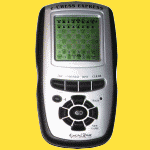
Travel


Drawing of a boy playing with a Radioshack portable chess computer.
Picture taken from a Radioshack chess computer box.
60-2168 - 1981
LCD Graduate Chess

Travel
60-2213 - 1996
Master 2200X

Table Top
60-2217 - 1998
Master Chess Computer

Table Top
60-2441 - 1994
Mega 2050X

Table Top
60-2428 - 1994
Partner 1680X Version I

Table Top
60-2428A - 1996
Partner 1680X Version II

Table Top
60-2256 - 1993
Pocket Chess 1100L

Travel
60-2252 - 1991
Portable 1650L

Travel
60-2444 - 1996
Portable 1750L

Travel
60-2426 - 1993
Sphinx Madrid Model 1300

Table Top

Drawing of two young people playing with a Radioshack portable chess computer.
Picture taken from a Radioshack chess computer box.
60-2255 - 1992
Talking Chess Tutor 1900L

Table Top
60-2709 - 2002
Talking E-Chess Version I

Travel
60-2846 - 2002
Talking E-Chess Version II

Travel
60-2160 - 1980
Tandy Computerized Chess I

Travel
60-2175 - 1983
Tandy Computerized Chess II
Travel
60-2219 - 1999
Travel Chess & Checkers

Travel
60-2253 - 1991
Super 1680L

Table Top
60-2427 - 1993
Go Chess Computer 1650L
Table Top