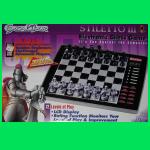
EXCALIBUR STILETTO III Electronic Chess Computer - picture taken from box
MAIN EXCALIBUR STILETTO III MODEL 932-ED GAME CHARACTERISTICS
- 72 Levels of Play
- Excalibur's Exclusive Teach Mode Teaches Beginners and Challenges Advanced Players
- Special Rating Function: Monitors Your Level of Play and Improvement
- 100’s of Preprogrammed Book Opening Positions
- Estimated Rating 1600
PLAYER RATING SYSTEM. How Good is Your Chess? Measure Your Progress
Your computer can estimate how strong you are as a chess player from the results you score against it and from the amount of time you take to think.
The computer adjusts your rating at the end of each game, according to the result of the game and the relative thinking times used by you and the computer.
The basic principles of the rating system are very simple. Let us start by assuming that you and the computer both use the same total time during a game and that you win the game. Since you won the game your rating will go up. The amount it goes up depends upon the rating difference between you and the computer before the game started.
If you were rated very much lower than the computer before the start if the game then the computer would be expected to beat you most of the time, so you will gain a lot of rating points for beating it. If you were rated slightly lower than the computer then you will gain fewer rating points. and if you were rated higher then the computer the you would be expected to beat it more often than not and so you will gain still fewer rating points for beating it.
On the other hand, if you lose a game against the computer you will lose rating points. If you had been rated below the computer before the game, you will lose comparatively few rating points if it beats you. But if you were rated higher than the computer before the game you will lose more rating points if it beats you.
Now let us consider what happens if you take much longer than the computer over your moves (of vice versa). If you take longer than the computer then you are, in effect, making yourself stronger than in the previous example because you are thinking more. The computer's rating system takes this into account and when it calculates your new rating, after a game, it first considers whether you or the computer took longer to think and, if so, by how much. So you will gain extra rating points for winning a game if you use less total thinking time than the computer, and you will gain fewer points for winning a game if you use more total thinking time than the computer.
The following scale indicates your playing category:
- If your rating is below 800 you are an absolute beginner.
- Between 800 and 1,000 you are a novice.
- From 1,000 to 1,200 you an intermediate player.
- From 1,200 to 1,500 you are an advanced player.
- Above 1,500, you are too strong for this computer and should think about an upgrade to a stronger model.
Excerpts taken from the Excalibur The Stiletto III user manual.
NOTE: The User Manual included with the Excalibur Stiletto III can be used for Models 922E, 923N, 932ED and 969WE .


Technical Specification
Excalibur Stiletto III (1996)
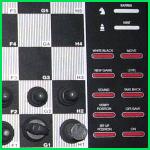

Box
Control Buttons
User Manual
Spacious Mind
Schachcomputer.Info
Active 2017
Tourn. 2015
1133
-
T1
T2
T3
T4
T5
Final
-
-
-
-
-
-
MANUFACTURER
PROGRAMMER
Excalibur Electronics, Inc
David Levy/Mark Taylor
1600 USCF
6/23/1996
$99.95
Not Available
Year:
MFR ELO:
Original Price:
Wiki ELO:
Model #:
932ED
My Serial #:
Not Available
Processor OEM
Timorite
Processor:
SC437609F
Speed:
Type:
8 Bit
2 MHz
ROM:
7744 Byte
RAM:
176 Byte
Battery Type:
4 x AAA
Power Adapter:
6V DC +/-
Display:
LCd 4 Pos 7 Seg
Board Type:
Press Sensory
Overall Size:
Board Size:
8x8 in
11.1/4x9.1/2x1
Options Select:
Button Select
Play Levels:
72
Opening Book:
250 Half Moves
Take Back:
2 Half Moves
Position Setup:
Available
Position Verify:
Available
Move Analysis:
Display Info:
Not Available
Not Available
Solve Mate:
Mate-in-2
Save Game:
Available
Ponder:
Not Available
Search Depth:
Not Known
Provide Hint:
Available
Teach Mode:
Not Available
Change Sides:
Available
Active Level:
TM Level:
LV 71
Infinite Level:
LV 72 (4-5 min)
LV 48
Hardware Specification
Game Features
Matchplay & Test ELO Ratings
Computer Game Rating
Rating Test
Other Computer Chess Ratings
USCF
USCF
Spacious Mind
Human Rating
USCF
CCR
CCNS
Ply
FIDE
USCF
-
-
-
1358
1219
Class D Level Electronic Table Top Chess Computer!