The MEPHISTO MODULAR/EXCLUSIVE/MUENCHEN - AMSTERDAM is built - as are all the chess-computers of the MEPHISTO family - to allow the unit to be completely disassembled.
The MEPHISTO MODULAR/EXCLUSIVE/MUENCHEN consists of easily interchangeable parts which enable the user to upgrade the unit at any time. It is therefore a simple affair to fit your MEPHISTO MODULAR, EXCLUSIVE OR MUENCHEN with an AMSTERDAM-module.
Excerpts taken out of the “Hegener + Glaser Mephisto Amsterdam User Manual

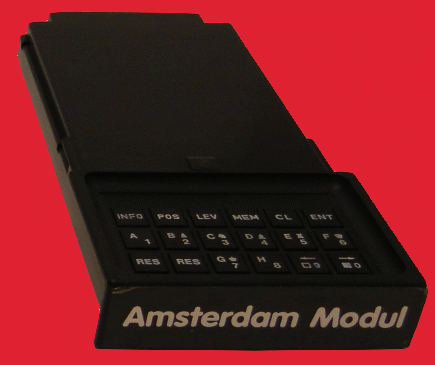
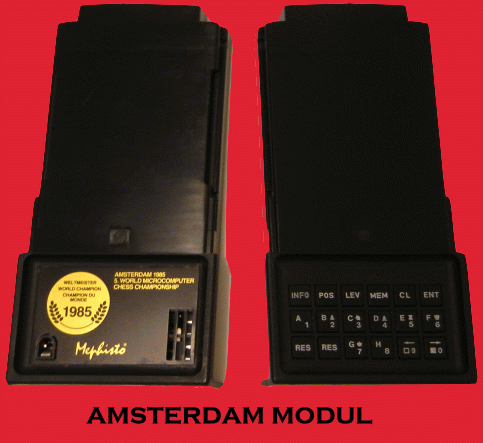
MEPHISTO AMSTERDAM 1985 World Champion. Close up of the program module.
About the Game Module
MEPHISTO Amsterdam has 7 playing levels, 10 problem levels, 1 correspondence chess level (infinite) and 1 optional time-setting level. Through the use of the optional time-setting level, MEPHISTO Amsterdam allows you to set your own playing levels for speed chess or tournament time settings of your choice. The possibilities are almost endless.
The microprocessor is a 16 Bit Motorola 68,000 running at 12 MHz. This was only the third time that Mephisto sold a Motorola 68,000 microprocessor chess program. It was however the first time that the Motorola 68,000 was made available at a more accessible price costing around DM 1,200 in Germany. The Motorola 68000 was first used with the MEPHISTO Excalibur in 1983 for a hefty price of DM 5,000 (approx. $2,500). The MEPHISTO Excalibur was a full-sized modular type chessboard similar to the ESB 6000 with a modified MEPHISTO III housing the Motorola 68000 processor, and one of the unknown MEPHISTO programs that had entered into the 1983 World Microcomputer Chess Championship in Budapest, Hungary. In 1984 the MEPHISTO Glasgow-S Module using the same Motorola 68,000 became Co-World Champion with Fidelity Elite X, Conchess X and the computer software program Psion in the World Microcomputer Chess Championship held that year in Glasgow, Scotland. The programming team of Thomas Nitsche and Elmar Henne developed the Glasgow-S. This was the first of many future World Microcomputer Chess Championship successes for MEPHISTO.
The big surprise of the 1984 World Microcomputer Chess Championship was the software program Psion written by Englishman Richard Lang finishing in joint first place.
Richard Lang joined MEPHISTO after the World Championship in 1984. His Psion program became the foundation for the new MEPHISTO Amsterdam program that won the 1985 World Microcomputer Chess Championship in Amsterdam.

Mephisto Amsterdam chess game module playing inside a Mephisto Muenchen Magnet-Sensory Board.
|
Board Name |
Board Type |
Compatible |
|
Mephisto Bavaria |
Hardwood Tournament Size |
No |
|
Exclusive |
Hardwood Table Top |
Yes |
|
Mirage Modular Board |
Plastic Table Top |
No |
|
Mobil with built-in Display |
Plastic Travel |
No |
|
Mobil with no Display |
Plastic Travel |
No |
|
Mephisto Modular Board |
Plastic Table Top |
Yes |
|
Mephisto Muenchen |
Hardwood Tournament Size |
Yes |
MEPHISTO AMSTERDAM MODULAR BOARD COMPATIBILITY CHART:


Technical Specification
Mephisto Amsterdam (1985) Chess Game Module


16 Bit Display
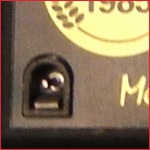
Power on Module
User Manual
Spacious Mind
Schachcomputer.Info
Active 2017
Tourn. 2015
1936
-
T1
T2
T3
T4
T5
Final
-
-
-
-
-
-
MANUFACTURER
PROGRAMMER
Hegener + Glaser
Richard Lang
2200 USCF
1988
$1495.00
1927
Year:
MFR ELO:
Original Price:
Wiki ELO:
Model #:
-
My Serial #:
0570031
Processor OEM
Motorola
Processor:
68000
Speed:
Type:
16 Bit
12 MHz
ROM:
64 KB
RAM:
16 KB
Battery Type:
Mains Only
Power Adapter:
Board Powered
Display:
Needs 16 Bit Disp
Board Type:
Needs ext. Board
Overall Size:
Not Applicable
3.3/4x7.5/8x3/4
Options Select:
Button Select
Play Levels:
Infinite Amount
Opening Book:
3000 Variations
Take Back:
All Moves
Position Setup:
Available
Position Verify:
Available
Move Analysis:
Display Info:
Available
5 ply main var.
Solve Mate:
Mate in 12
Save Game:
Available
Ponder:
Available
Search Depth:
14 ply max.
Provide Hint:
Available
Teach Mode:
Not Available
Change Sides:
Available
Active Level:
TM Level:
6
Infinite Level:
9
3
Hardware Specification
Game Features
Matchplay & Test ELO Ratings
Computer Game Rating
Rating Test
Other Computer Chess Ratings
USCF
USCF
Spacious Mind
Human Rating
USCF
CCR 1994
CCNS 1994
Ply 1994
FIDE
USCF
2125
2093
2105
1971
2022
Top View of Mephisto Amsterdam Module inside Mephisto Muenchen Modular Chess Board

Expert Level Electronic Chess Module!
Board Size:
18 Key Control Module
1985 World Champion (WMCCC) Game Module