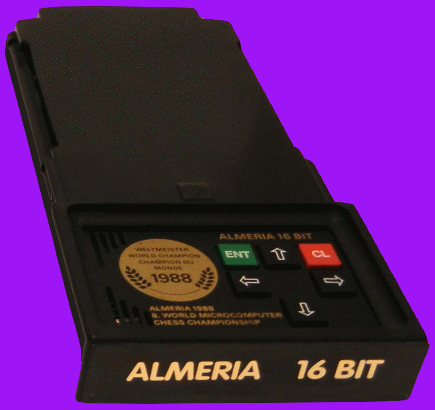
At the 9th World Microcomputer Chess Championship, which was held at Almeria, Spain, from September 24th to October 1st, 1988, Almeria became World Champion. Once again MEPHISTO dominated as it had done before in Glasgow (1984), Amsterdam (1985), Dallas (1986), and Rome (1987). This run of world championship success surely proved that that the worlds best chess programmer Richard Lang once again managed to improve the strength of his program. The improvement made by MEPHISTO and Richard Lang were numerous:
Hardware:
For the first time in a factory produced chess computer the enormous working memory capacity of 512 KB RAM (with Almeria 16 Bit with Motorola 68,000 processor) and 1024 KB (with Almeria 32 Bit) was introduced to the world of chess computers. This allowed the processing speed for a move to be increased considerably, compared to all previous chess computers.

Picture shows Mephisto Almeria 16 Bit game module control keys. There are 4 directional keys an 1 enter and 1 clear key. These keys are used to set the levels and game options on the 32 Bit LCD Display module.
Software:
The software has been improved in many areas:
Opening:
The opening library has been increased to about 7.000 variations with about 60,000 half-moves, which makes the program even more attractive to play with.
Middle game:
More chess knowledge was developed in this area of the game through improved strategical knowledge especially in pawn structure awareness. A more active game and pressing game together with pieces working harmoniously together greatly increased the play in the middle game.
Endgame:
Improved handling of advanced and connected passed pawns as well as improved King maneuverability in the endgame. Enormous increase of computing speed due to the use of hash tables.
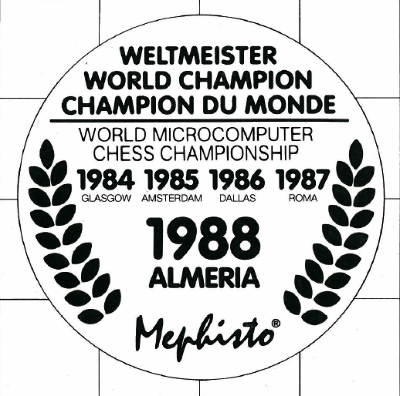
Picture shows “Almeria 1988” this was Mephisto’s and programmer Richard Lang's 5th consecutive World Microcomputer Chess Championship (WMCCC) success.
New 16/32 Bit Display Module
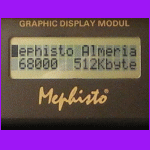
This was the first time that MEPHISTO introduced a 32-digit display dot matrix display module. This greatly improved the menu driven dialog with the game options and functions.
The program was sold in three versions: Motorola 68000, 68020 and 68030 microprocessors. This version is the Motorola 68000 16 Bit version. The playing strength is approximately ELO 2280 USCF.

Mephisto Almeria 16 Bit chess game module playing inside a Mephisto Muenchen Magnet-Sensory Board.
|
Board Name |
Board Type |
Compatible |
|
Mephisto Bavaria |
Hardwood Tournament Size |
No |
|
Exclusive |
Hardwood Table Top |
Yes |
|
Mirage Modular Board |
Plastic Table Top |
No |
|
Mobil with built-in Display |
Plastic Travel |
No |
|
Mobil with no Display |
Plastic Travel |
No |
|
Mephisto Modular Board |
Plastic Table Top |
Yes |
|
Mephisto Muenchen |
Hardwood Tournament Size |
Yes |
MEPHISTO ALMERIA 16 BIT MODULAR BOARD COMPATIBILITY CHART:


Technical Specification
Mephisto Almeria 16 Bit (1988) Chess Game Module


16 Digit Display
Show Module
User Manual
Spacious Mind
Schachcomputer.Info
Active 2015
Tourn. 2017
2099
2083
T1
T2
T3
T4
T5
Final
-
-
-
-
-
-
MANUFACTURER
PROGRAMMER
Hegener + Glaser
Richard Lang
2250 German
1988
$1495.00
2015
Year:
MFR ELO:
Original Price:
Wiki ELO:
Model #:
-
My Serial #:
0608489
Processor OEM
Motorola
Processor:
68000
Speed:
Type:
16 Bit
12 MHz
ROM:
128 KB
RAM:
512 KB
Battery Type:
Mains Only
Power Adapter:
Board Powered
Display:
Needs 16/32 Disp
Board Type:
Needs ext. Board
Overall Size:
Not Applicable
3.3/4x7.5/8x3/4
Options Select:
Button Select
Play Levels:
Infinite Amount
Opening Book:
7000 Variations
Take Back:
All Moves
Position Setup:
Available
Position Verify:
Available
Move Analysis:
Display Info:
Available
8 ply main var.
Solve Mate:
Mate in 16
Save Game:
Available
Ponder:
Available
Search Depth:
31 ply max.
Provide Hint:
Available
Teach Mode:
Not Available
Change Sides:
Available
Active Level:
TM Level:
TOURN 03
Infinite Level:
INFIN
NORML 04
Hardware Specification
Game Features
Matchplay & Test ELO Ratings
Computer Game Rating
Rating Test
Other Computer Chess Ratings
USCF
USCF
Spacious Mind
Human Rating
USCF
CCR 1994
CCNS 1994
Ply 1994
FIDE
USCF
2200
2180
2199
2123
2185
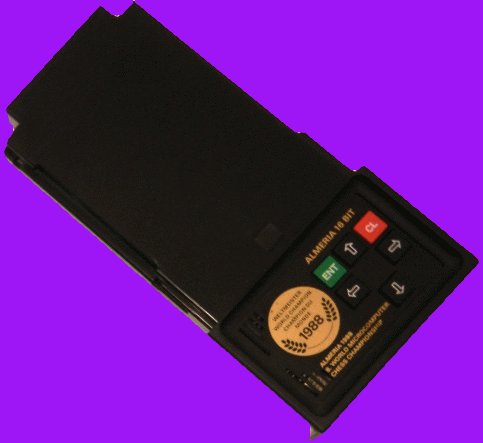
Top View of Mephisto Almeria 16 Bit Module inside Mephisto Muenchen Modular Chess Board

Expert Level Electronic Chess Module!
Board Size:
6 Key Game Module - 16 Bit Motorola 68,000 Processor
16/32 Bit Dot Matrix Display Module